Sourdough baking sounds simple until you actually try it. You mix flour and water, wait patiently, and expect a beautiful loaf. But then the results come out disappointing. Flat loaves, pale crusts, and dense interiors are common problems, and most of the time, your oven is the reason.
Sourdough needs very specific conditions. It requires high heat to create oven spring, steady temperature to maintain structure, and trapped steam to develop a proper crust. Most standard ovens struggle to deliver all three at the same time. They lose heat quickly, have uneven hot spots, and make steam control difficult.
The good news is that you don’t need a professional bakery setup to fix this. The best toaster oven for baking sourdough bread can give you a smaller, more controlled environment that actually improves consistency and results.
This guide breaks down the best options available right now and helps you choose the right one based on your needs.
We also have an article on toaster vs toaster oven if you want to explore your options first.
| Product Name | Best For | Max Temp | Price |
|---|---|---|---|
| Breville BOV900BSS | Best Overall | 450°F | |
| Cuisinart TOA-70 | Best Value | 450°F | |
| Ninja DT201 Foodi | Best Large Capacity | 450°F | |
| Panasonic FlashXpress | Best Compact | 500°F | |
| Hamilton Beach 31123D | Best for Beginners | 450°F |
Table of Contents
Our Top Pick: Breville BOV900BSS Smart Oven Air Fryer Pro
If you want predictable, repeatable sourdough results, this is the oven that gives you control.
One of the biggest challenges in sourdough baking is fermentation. Temperature affects how your dough rises, and small fluctuations can completely change your outcome. This oven solves that problem with a dedicated proof setting. It creates a stable low-heat environment where your dough can rise consistently every time.
Another major advantage is the PID temperature control. Unlike standard ovens that cycle on and off, this system continuously adjusts heat to maintain a steady temperature. That stability directly improves oven spring and crust formation.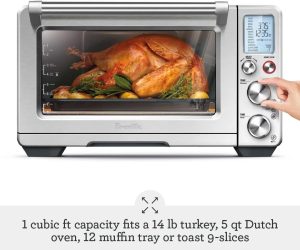
Space is another critical factor. This oven is large enough to fit a 5-quart Dutch oven, which is essential for trapping steam during the early stage of baking. Without steam, your crust won’t develop properly, and your loaf won’t expand as it should.
On top of that, you get 13 cooking functions. That includes baking, proofing, slow cooking, and dehydrating. It replaces multiple appliances and adds flexibility to your kitchen.
What really sets this oven apart is how all these features work together. You get controlled fermentation, stable baking conditions, and proper steam support in one unit. That combination is rare.
This is why it stands out as the best toaster oven with proofing function for serious sourdough bakers.
5 Best Toaster Oven Reviews
Breville BOV900BSS (Best Overall)

This oven is designed for people who want consistent results. It removes most of the guesswork from sourdough baking and replaces it with control.
The heating system adapts automatically, and the airflow ensures even baking from all sides. It feels closer to a professional baking setup than a typical kitchen appliance.
Key Specs:
- 1800 watts
- 1 cubic ft capacity
- 13 functions
- Max temp: 450°F
Pros
- Element IQ system adjusts heat precisely
- Built-in proofing function for fermentation
- Super convection fan ensures even heat
- Fits 5 qt Dutch oven comfortably
- Large interior for versatile baking
Cons
- Higher price than other models
- Requires more counter space
Cuisinart TOA-70 (Best Value)

This oven focuses on delivering reliable performance at a lower cost. It doesn’t include advanced features, but it handles the basics well.
It provides enough heat and airflow to produce good sourdough loaves without overcomplicating the process.
Key Specs:
- 1800 watts
- Medium capacity
- 8 functions
- Max temp: 450°F
Pros
- Strong convection baking performance
- More affordable option
- Fits smaller Dutch ovens
- Simple controls
Cons
- No proofing function
- Less precise temperature control
Ninja DT201 Foodi (Best Large Capacity)
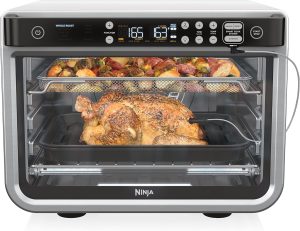
This oven is built for space and flexibility. If you bake large loaves or multiple batches, it gives you room to work.
The strong convection system ensures that heat circulates evenly, even in a larger interior.
Key Specs:
- 1800 watts
- XL capacity
- 10 functions
- Max temp: 450°F
Pros
- Large interior for big loaves
- Strong airflow for even baking
- Can handle multiple items at once
- Digital controls for accuracy
Cons
- Takes up more space
- Fan noise can be noticeable
Panasonic FlashXpress (Best Compact)
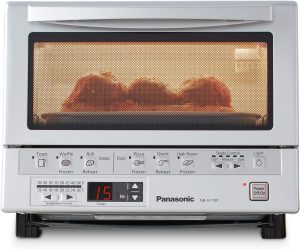
This oven proves that small doesn’t mean weak. It heats up quickly and reaches higher temperatures than most models.
It’s ideal for people with limited kitchen space.
Key Specs:
- 1300 watts
- Compact size
- 6 functions
- Max temp: 500°F
Pros
- Extremely fast heating
- Highest max temperature
- Compact footprint
- No preheating required
Cons
- No convection fan
- Cannot fit a Dutch oven
Hamilton Beach 31123D (Best for Beginners)
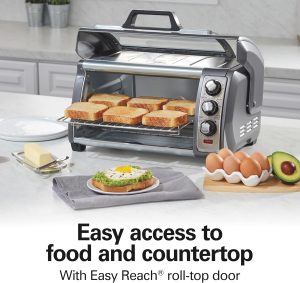
This is a practical option for beginners. It keeps things simple while still offering enough power for decent results.
It allows you to learn sourdough baking without a large investment.
Key Specs:
- 1500 watts
- Medium-small capacity
- Basic functions
- Max temp: 450°F
Pros
- Easy to use
- Affordable
- Includes convection setting
- Good for beginners
Cons
- Smaller interior
- No proofing function
What to Look For While Buying the Best Toaster Oven for Baking Sourdough Bread
Temperature Range
Temperature is one of the most important factors in sourdough baking. Your oven must reach at least 450°F to create proper oven spring. That initial burst of heat is what causes the dough to expand rapidly before the crust sets. Without it, your loaf will come out dense and flat instead of tall and airy.
Higher temperatures produce better crust and faster expansion. Ideally, you want an oven that can push close to 500°F, especially if you are chasing that dark, blistered crust seen in artisan bakeries. High heat also helps gelatinize the starches on the surface of the dough, which is what gives sourdough its signature shine and crisp texture.
The problem is that many toaster ovens overpromise and underdeliver. They might say 450°F on the dial, but in reality, they fluctuate or never fully reach that level. This inconsistency affects your results more than you might expect. Even a small drop in temperature during the first 10 minutes of baking can reduce oven spring significantly.
That is why using an oven thermometer is not optional. It gives you a clear picture of what is actually happening inside your oven. You might discover that your oven runs cooler or hotter than expected, and once you know that, you can adjust your settings accordingly.
Another factor to consider is heat recovery. When you open the door to load your dough, the temperature drops. A good toaster oven should recover quickly and return to the target temperature within a short time. Faster recovery means more consistent baking conditions.
Preheating also plays a role here. It is not enough for the oven to simply reach the target temperature. The walls, heating elements, and any baking vessel inside must also absorb and hold heat. This is what creates a stable environment for baking. That is why a longer preheat time often leads to better results.
In simple terms, you are not just looking for high temperature. You are looking for accurate, stable, and consistent heat that stays where it should throughout the bake.
Convection Setting
The best convection toaster oven for bread baking uses a fan to circulate hot air throughout the interior. This airflow helps distribute heat evenly, which is critical when baking sourdough.
Without convection, heat tends to build up in certain areas while leaving others cooler. This leads to uneven baking. You might end up with a loaf that is overcooked on one side and undercooked on another. The bottom might burn while the top stays pale.
A convection fan solves this by constantly moving hot air around the loaf. This creates a more uniform temperature throughout the oven. As a result, your crust develops evenly, and your bread bakes more consistently from all angles.
Another benefit of convection is efficiency. Because the hot air is constantly circulating, heat transfer happens faster. This can improve oven spring and reduce baking time slightly. It also helps maintain temperature stability when the door is opened.
However, convection is not always a simple on-or-off feature. Some ovens have stronger fans than others. High-end models often include multiple fan speeds or advanced airflow systems. These can make a noticeable difference in how evenly your bread bakes.
There is also a practical side to consider. Convection can sometimes dry out the surface of your dough if used too aggressively, especially in the early stages of baking. That is why many bakers prefer to combine convection with a Dutch oven or steam method. The steam protects the dough surface while the convection ensures even heat.
If your oven does not have convection, you can still bake sourdough. But you will need to adjust your process. Rotating the loaf halfway through baking can help compensate for uneven heat. It is an extra step, but it can make a big difference.
In the end, convection is not strictly required, but it is a major advantage. It simplifies the process and improves consistency, especially if you bake regularly.
Interior Size
Interior size is often overlooked, but it has a direct impact on how you bake sourdough. Your oven must fit a Dutch oven if you want to trap steam effectively. A minimum size of 12″ x 12″ is recommended, but larger is always better.
Steam is essential for proper crust development. When your dough enters a hot, steamy environment, the surface stays flexible for longer. This allows the loaf to expand fully before the crust sets. Without steam, the crust forms too early and restricts growth.
A Dutch oven is one of the easiest ways to create this environment. It traps moisture released from the dough and turns it into steam. But if your toaster oven cannot fit a Dutch oven, you lose this advantage.
This is where interior size becomes critical. A cramped oven limits your options. You may be forced to bake smaller loaves or use alternative steam methods, which are often less effective.
Larger interiors give you more flexibility. You can bake different loaf sizes, experiment with different techniques, and even bake multiple loaves at once. This is especially useful if you bake frequently or for a family.
Height is just as important as width. Some ovens are wide enough but lack vertical space. This can be a problem if your loaf rises significantly during baking or if your Dutch oven has a lid with a handle.
Another factor to consider is airflow. A larger interior allows better air circulation around the loaf. This improves heat distribution and helps create a more even crust.
If you are serious about sourdough, it is worth choosing an oven that does not limit your baking options. A slightly larger footprint on your counter can translate into much better results in the long run.
Proofing Function
A proofing function provides a controlled environment for fermentation. It keeps temperatures between 80 and 90°F, which helps your dough rise consistently.
Fermentation is one of the most unpredictable parts of sourdough baking. It depends heavily on temperature, and small changes can have a big impact. If your kitchen is too cold, your dough may rise slowly or not at all. If it is too warm, fermentation can happen too quickly and affect flavor and structure.
A proofing function removes this uncertainty. It gives you a stable environment where your dough can develop at a steady pace. This leads to more predictable results and better control over your baking schedule.
This is especially useful if you live in a place where temperatures fluctuate throughout the day. Instead of adjusting your process constantly, you can rely on the oven to maintain the right conditions.
Another advantage is consistency. When you use the same proofing conditions every time, you start to understand how your dough behaves. This makes it easier to improve your technique and replicate successful bakes.
Not all toaster ovens include this feature. It is more common in higher-end models. If sourdough baking is something you plan to do regularly, it is worth considering.
That said, you can still proof dough without this function. Many bakers use simple methods like placing the dough in a warm spot or using a turned-off oven with the light on. These methods work, but they require more attention and can be less consistent.
A proofing function is not essential, but it simplifies the process and reduces guesswork. For many bakers, that convenience alone makes a big difference.
Even Heat Distribution
Even heat is essential for consistent baking. Without it, your results will vary from one bake to the next.
Look for ovens with both top and bottom heating elements. This ensures that heat reaches your loaf from all sides. If an oven only heats from the top, you are more likely to get uneven results.
Uneven heat can cause several problems. The bottom of your loaf might burn while the top remains pale. One side might rise more than the other. These issues are frustrating because they are hard to fix without changing your equipment.
Premium models often include advanced systems that improve heat distribution. PID temperature control is one example. It continuously adjusts heat output to maintain a stable temperature. This reduces fluctuations and creates a more controlled baking environment.
Multiple heating elements also help. Instead of relying on a single source of heat, the oven distributes energy more evenly across the interior. This reduces hot spots and improves overall performance.
Rack position matters as well. Placing your loaf too close to the top or bottom heating element can lead to uneven baking. A well-designed oven gives you enough space to position your bread properly.
Even heat distribution becomes more important as you improve your baking skills. Once your technique is consistent, the oven becomes the limiting factor. Investing in a model with good heat distribution helps you get the most out of your efforts.
Easy to Clean
Sourdough baking can get messy quickly. Flour, sticky dough, and burnt bits can build up inside your oven over time.
A removable crumb tray makes cleaning much easier. Instead of scraping the bottom of the oven, you can simply remove the tray and wipe it clean. This saves time and keeps your oven in good condition.
Non-stick interiors are another useful feature. They prevent food and residue from sticking to the surface, which makes cleaning faster and easier.
Regular cleaning is important not just for hygiene but also for performance. Built-up residue can affect airflow and heat distribution. Over time, this can reduce the efficiency of your oven.
It is also worth considering how accessible the interior is. Some ovens are easier to reach and clean than others. A well-designed interior allows you to clean all surfaces without difficulty.
If you bake frequently, these small details matter. An oven that is easy to clean encourages you to maintain it properly, which helps it perform better in the long run.
Counter Space
Counter space is a practical consideration that you should not ignore. Larger ovens tend to perform better, but they also take up more room.
Before buying, measure your available space carefully. Make sure there is enough room not just for the oven itself but also for ventilation. Toaster ovens generate heat, and they need space around them to operate safely.
Compact ovens are easier to fit into small kitchens, but they often come with trade-offs. They may have smaller interiors, weaker airflow, or fewer features. This can limit your baking options.
On the other hand, larger ovens provide more flexibility. They allow you to bake bigger loaves, use Dutch ovens, and experiment with different techniques. If you have the space, they are usually the better choice.
You also need to think about placement. The oven should be easy to access and use. If it is tucked away in a corner, it becomes less convenient.
Check our guide on under cabinet toaster ovens to save counter space.
In the end, it is about balance. Choose an oven that fits your space but also meets your baking needs. Sacrificing too much capacity for the sake of space can limit your results.
Tips for Baking Sourdough in a Toaster Oven
Use a Dutch Oven
Using the toaster oven sourdough dutch oven method is one of the most effective ways to improve your results. It solves the biggest problem in sourdough baking, which is steam.
When your dough first goes into the oven, it needs a humid environment. This keeps the outer layer soft so the loaf can expand fully. If the surface dries too early, it hardens and restricts growth. That is how you end up with flat or dense bread.
A Dutch oven traps moisture released from the dough and turns it into steam. This creates a mini baking chamber inside your toaster oven. The result is better oven spring, a thinner crust, and that glossy finish you see on bakery bread.
Even in a smaller toaster oven, a Dutch oven can make a big difference. If your oven cannot fit a 5-quart pot, you can use a smaller one. A 2-quart Dutch oven still works well for smaller loaves.
If a Dutch oven is not an option, you can try alternatives. A metal tray with water placed inside the oven can generate steam, but it is less effective. Spraying water into the oven is another method, but it is inconsistent and can be risky for electrical components.
The key idea is simple. Steam in the early stage of baking leads to better structure and crust. The Dutch oven is just the easiest and most reliable way to achieve that.
Check Actual Temperature
One of the biggest mistakes beginners make is trusting the oven display. Many toaster ovens are not accurate. They can be off by 25 to 50 degrees without you realizing it.
This might not sound like a big difference, but in sourdough baking, it matters a lot. A lower temperature reduces oven spring and leads to a dense loaf. A higher temperature can burn the crust before the inside is fully cooked.
That is why an oven thermometer is essential. It gives you a real reading of the internal temperature. Once you know how your oven behaves, you can adjust your settings accordingly.
For example, if your oven says 450°F but the thermometer shows 420°F, you know you need to increase the setting. Over time, you will learn how your oven responds and develop a more consistent process.
Temperature accuracy also affects timing. If your oven runs cooler, your bread may need more time to bake. If it runs hotter, you may need to reduce the baking time slightly.
Another factor to watch is temperature fluctuation. Some ovens cycle heat on and off, causing swings in temperature. These swings can affect how your bread rises and bakes.
Checking your temperature regularly helps you catch these issues early. It removes guesswork and gives you more control over your results.
Make Smaller Loaves
Toaster ovens are compact by design. That means you need to adjust your baking approach to match the space available.
Making smaller loaves is one of the easiest ways to improve your results. Smaller dough portions heat more evenly and bake more consistently. They also allow better airflow around the loaf, which helps with crust development.
If you try to bake a large loaf in a small oven, several problems can occur. The top may get too close to the heating elements and burn. The inside may remain undercooked because heat cannot penetrate evenly. The loaf may also expand unevenly due to limited space.
Dividing your dough into two smaller loaves solves these issues. It gives each loaf enough room to expand and bake properly. You may end up with two smaller breads instead of one large one, but the quality will be much better.
Smaller loaves also bake faster. This can be useful if you want to save time or bake multiple batches.
Another advantage is flexibility. You can experiment with different shapes and techniques without worrying about space limitations. For example, you can try round boules, oval batards, or even smaller rolls.
The goal is to work with your oven, not against it. Once you adapt your loaf size to the available space, you will see more consistent results.
Preheat Longer
Preheating is often underestimated, especially with toaster ovens. Because they heat up quickly, it is easy to assume they are ready as soon as the indicator light turns on.
In reality, proper preheating takes longer. You need to give the oven enough time for the entire interior to reach a stable temperature. This includes the walls, racks, and any baking vessel inside.
For sourdough, this is critical. The moment your dough enters the oven, it should be exposed to strong, consistent heat. This is what triggers oven spring.
If the oven is not fully preheated, the temperature will drop when you open the door. This delays oven spring and affects the final structure of your bread.
A good rule is to preheat for at least 20 to 30 minutes. If you are using a Dutch oven, preheat it inside the oven as well. A hot Dutch oven helps create instant steam when the dough is placed inside.
Longer preheating also improves temperature stability. The oven will be less affected by heat loss when you open the door.
It may feel like a small step, but it has a big impact on your results. Proper preheating sets the stage for everything that follows.
Score the Dough Right Before Baking
Scoring is more than just decoration. It controls how your bread expands in the oven.
When you score your dough, you create a weak point in the surface. This allows the loaf to expand in a controlled way. Without scoring, the pressure builds up and can cause random cracks.
Timing is important here. You should score your dough right before placing it in the oven. If you score too early, the cut can close up as the dough relaxes. This reduces its effectiveness.
Using a sharp blade or a lame makes a big difference. A clean cut allows the dough to open properly during baking. A dull blade can drag the surface and create uneven results.
The angle of the cut also matters. A shallow angle encourages the loaf to open up and form an “ear,” which is a classic feature of well-baked sourdough.
Practice helps you improve your scoring technique. Over time, you will learn how different cuts affect the final shape of your bread.
Scoring may seem like a small detail, but it plays a big role in both appearance and structure.
Watch the Timer
Many toaster ovens include an automatic shut-off feature. This is designed for safety, but it can interfere with baking if you are not careful.
Sourdough baking often takes longer than standard cooking tasks. If your oven shuts off in the middle of a bake, the temperature drops suddenly. This can affect the crust and overall structure of your bread.
To avoid this, always check your oven’s timer settings. Set it to the maximum duration or use a “stay on” mode if available.
It is also a good idea to use a separate kitchen timer. This helps you track your baking time without relying entirely on the oven.
Timing is important at every stage. The first part of baking is focused on oven spring and steam. The second part is about drying out the crust and finishing the bake.
If your oven shuts off too early, you may end up with a loaf that looks done on the outside but is still undercooked inside.
Keeping track of time ensures that your bread bakes fully and evenly.
Manage Steam Properly
Steam management is one of the most important skills in sourdough baking. It affects both oven spring and crust development.
In the early stage of baking, you want as much steam as possible. This keeps the surface of the dough flexible and allows it to expand fully.
After the initial phase, you want to remove the steam. This allows the crust to dry out and become crisp.
If you are using a Dutch oven, this process is simple. You keep the lid on for the first part of the bake, then remove it to finish.
If you are not using a Dutch oven, you need to create and control steam manually. This can involve adding water to a tray or using other methods.
The key is timing. Too little steam early on limits expansion. Too much steam later can result in a soft or chewy crust instead of a crisp one.
Learning how to manage steam takes practice, but it has a huge impact on your results.
Adjust Based on Your Oven
Every toaster oven behaves differently. Even two units of the same model can perform slightly differently.
That means you need to observe and adjust. Pay attention to how your bread bakes. Look at the crust, the color, and the rise.
If the bottom burns, try raising the rack position. If the top browns too quickly, lower the temperature slightly or use foil to shield it.
If your bread is dense, check your temperature and proofing process. Small adjustments can make a big difference.
Keeping notes can help you improve faster. Write down what worked and what didn’t. Over time, you will develop a process that suits your specific oven.
The goal is consistency. Once you understand your oven, you can repeat successful results more easily.
Be Patient and Consistent
Sourdough baking is not about quick results. It is about consistency and gradual improvement.
Your first few loaves may not be perfect, and that is normal. Each bake teaches you something new about your dough and your oven.
Stick to a simple process and refine it over time. Avoid changing too many variables at once. This makes it easier to identify what works.
Patience also applies to fermentation and baking time. Rushing the process often leads to poor results.
Consistency is what turns good bread into great bread. Once you develop a routine, your results will improve naturally.
For a step-by-step visual guide, watch this YouTube video:
FAQ
Wrapping Up
Sourdough baking depends on heat, steam, and consistency. Without these, results will always vary.
Any of the ovens listed here can work, but the Breville offers the most control and reliability. It simplifies the process and improves consistency.
If you want dependable results, it remains the best toaster oven for baking sourdough bread available today.
References:
pantrymama.com/toaster-oven-sourdough
thefreshloaf.com/node/64722
kingarthurbaking.com/blog/2023/08/08/smart-oven-air-fryer
kitchenasking.com
consumerreports.org
breville.com/en-us/product/bov900